
SAFE & STABLE HOMES
We can’t always change the reasons for family homelessness, but we can change the way our system responds to these reasons.
Safe & Stable Homes: Ending Family Homelessness
We have met Our goal of Ending family homelessness in our four-county footprint.
We have met the 58 criteria established by the U.S. Interagency Council on Homelessness for ending family homelessness in Milwaukee, Ozaukee, Washington, and Waukesha counties. We are grateful to everyone who have partnered with us. Together, we’ve built strategies, set goals, secured grants, launched programs, expanded existing programs, and so much more.
The Challenges
Six years ago, we uncovered a stark reality: about 5,000 students were experiencing homelessness during a typical school year across our four counties, and each month, 40–50 families were entering local homeless shelters.
At that time in Wisconsin, one in three people experiencing homelessness were part of a family with a child under the age of 18.
That’s when United Way and community members decided something had to be done. We brought together an advisory council of homelessness experts to delve into this stark reality: family homelessness was far more common than most people realized.
We knew we couldn’t change the circumstances that lead to family homelessness, but we could ge how our system responds to these circumstances.
The Solutions
In December 2025, United Way and partners in our community reached a major milestone: we achieved our goal of ending family homelessness across our four-county region. This was only possible through support from our donors.
We partner with local nonprofits to provide:

Shelter and housing support. We connect families to immediate shelter, transitional housing, and permanent homes. We work to ensure no family experiences unsheltered homelessness and help move families into stable housing as quickly as possible.

Legal aid. We provide free, same-day legal support in housing court, along with ongoing legal assistance and tenant–landlord mediation. These services help prevent evictions and keep families in their homes.

Flexible financial assistance. We offer tiered financial support paired with housing case management. We prioritize families at risk of crisis, stepping in early to prevent homelessness before it starts.

Wraparound support. We guide families through housing navigation and continue support after they are housed. Our case management addresses everyone: parents, children, and even pets.
The Results
In 2024–25, our community delivered results that helped families stay stably housed. Together:
- We supported 4,600 families through Safe & Stable Homes programs, helping parents keep their housing and children maintain stability at home and in school.
- The Milwaukee Rental Housing Resource Center connected over 17,700 households to rental assistance, legal support, and mediation services. They also reached more than 70,000 tenants and landlords online with tools and guidance that help prevent housing crises before they start.
- We provided free legal help to nearly 3,000 families facing eviction, helping them stay in their homes and avoid displacement during already stressful moments.
- Across our four counties, we activated 24 coordinated programs delivering flexible financial assistance, case management, legal aid, and school-based housing support so families get help when they need it most.
These efforts don’t just respond to crisis, they prevent it. Because of the support of thousands of people in our community, families are more stable and now have pathways to long-term housing security.
In 2024–25, United Way provided funding to organizations, focused on:
- Providing community case management.
- Offering financial assistance.
- Covering closing costs for homeowners.
- Coordinating access to resources and supportive housing for individuals and families.
- Delivering wraparound supportive services for families.
What We Fund
View a full listing of the 2025-26 Safe & Stable Homes grantees.
What's Next?
While we celebrate our achievement, we recognize that sustaining positive outcomes requires ongoing support. Challenges persist, and there is more work to be done to ensure every family has a safe and stable home. Your continued support will be crucial in maintaining momentum and addressing evolving needs. By joining United Way on this ongoing journey, donors play a vital role in shaping a community where safe and stable housing is a lasting reality for every family.
- Sustainability of success is outlined by one of the key criteria set by USICH for ending family homelessness as such:
- Our community can project the number of families who may need shelter and services.
- Sufficient resources are dedicated to prevention strategies and programs that make episodes of homelessness brief.
- Cross-sector connections are leveraged to maintain household stability.
Across the U.S.
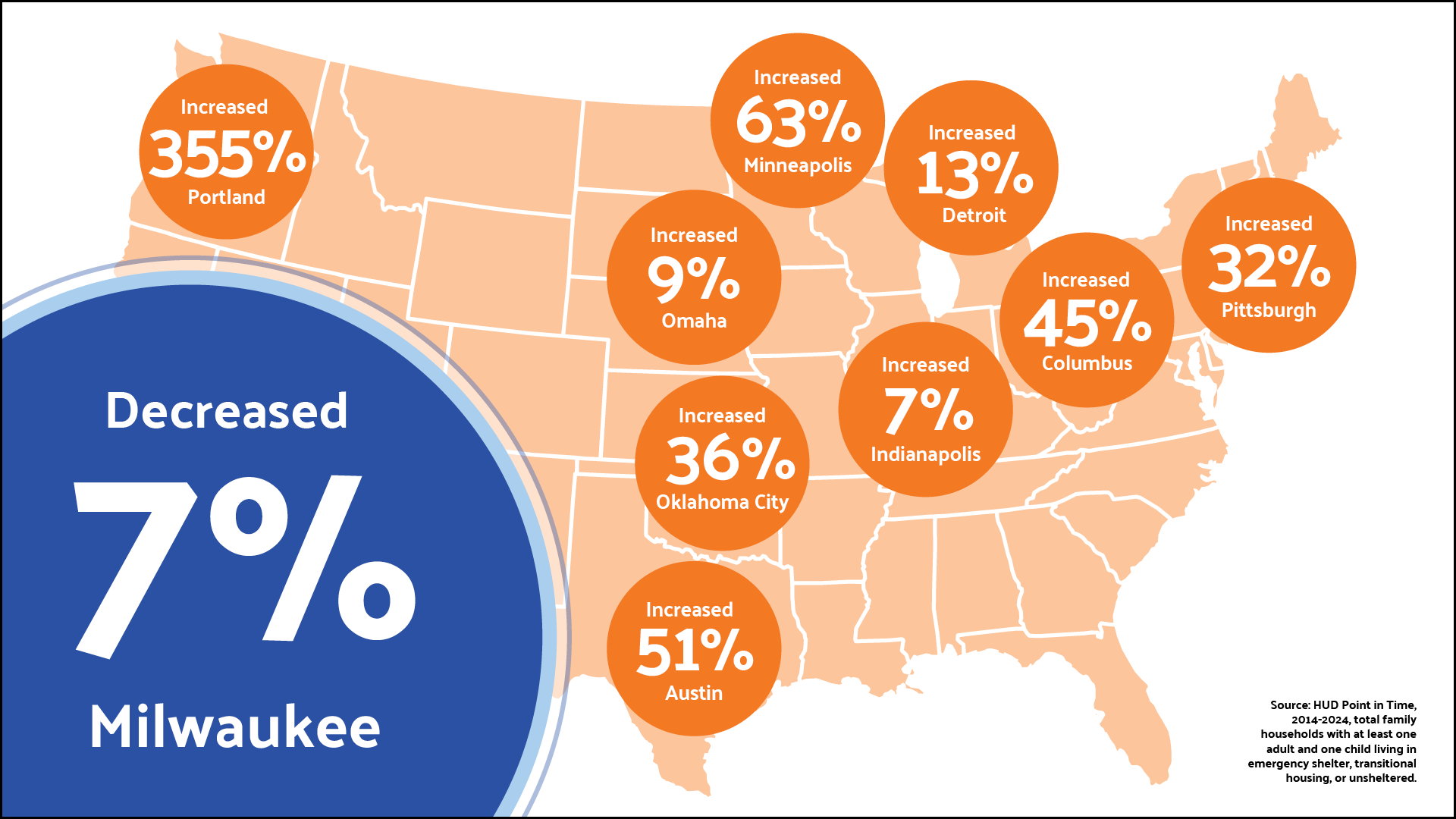
Since 2019, family homelessness has increased in this United States by 49%.
During the same period in Milwaukee, family homelessness decreased 7%.
Every city has their own story, but the end result is simple: all similar mid-sized cities had increases. Except one. Ours.
StrategY Details
We understand what it takes to prevent homelessness, and at United Way, we’re actively implementing proven strategies from successful models in other communities. Our commitment to success is reflected in our substantial investment – approximately $14 million since 2020 – dedicated to strategies that effectively prevent and swiftly end homelessness. Annually, around 9,000 households benefit from the programs offered by Safe & Stable Homes.
To achieve cross-county success, United Way of Greater Milwaukee & Waukesha County partners with experts at the Milwaukee Continuum of Care, Waukesha Housing Action Coalition, and United Way of Northern Ozaukee. Together, we apply the following pivotal strategies:
Collective Impact Model
Safe & Stable Homes uses the Collective Impact model outlined by the Stanford Social Innovation Review. This prioritizes a shared understanding of the issue across all stakeholders, data sharing, mutually reinforming strategies across sectors and continuous communication facilitated by United Way as the backbone of coordination.
Legal Aid & Mediation
Eviction Defense Project (EDP)
Legal Action of Wisconsin's Eviction Defense Project provides free, same-day legal representation for families in eviction cases in Milwaukee small claims court. In addition to same-day legal representation, the EDP can provide advice to tenants, as well as assist tenants with post-judgement matters, such as motions to clarify CCAP records. EDP has been able to seal dismissed cases almost ten times as often as unrepresented tenants. EDP works in concert with other housing service providers by accepting referrals for clients with same-day representation when they otherwise have not secured extended representation before their case. With the help of attorneys and students across Milwaukee County who volunteer their time pro bono, the EDP is able to help anywhere from six to 12 otherwise unrepresented families facing eviction per day.
Eviction Free MKE (EFM)
EFM provides pro-bono extended legal representation for families in eviction cases in Milwaukee County small claims court. Eligible tenants must be from Milwaukee County and have incomes at or below 200% of federal poverty guidelines.
Mediate WI Tenant/Landlord Mediation
In this program, professional mediators de-escalate tension between tenants and landlords, help them find common interests or goals, connect with available financial and supportive services, and craft an individualized solution that makes sense to both parties. This grant serves households across Milwaukee, Waukesha, Washington, and Ozaukee counties and closely collaborates with the Rental Housing Resource Center.
Flexible Financial Assistance & Wraparound Support
Family Flex Fund
Provides tiered case management and flexible financial aid for families that would otherwise be using crisis services to prevent an episode of homelessness.
Rent, Utility, and Flexible Assistance
Various programs provide specific (delinquent property tax, utility bill, etc.) or flexible financial assistance to clients with unique eligibility for each program. For example, parents returning from incarceration or veteran-led families.
Community Case Management (CCM)
In partnership with the Greater Milwaukee Foundation, CCM programs provide flexible financial assistance for community case managers covering security deposits, first month’s rent, monthly bus passes, moving expenses, move-in supplies, and food-related gift cards. Flexible funds allow case managers to provide their clients with the amount and type of support they need to achieve stability as determined by Individualized Plans for Independence.
School-Based Housing Case Management
The School-Based Housing Case Management program is run in partnership with the Siemer Institute for Family Stability. Students with frequent school mobility have a challenging time focusing on education. Housing case managers work with Milwaukee Public Schools to identify students that frequently change schools due to housing insecurity. Housing case managers then wrap those students’ families with supportive services, including rent assistance and case management. The goal is to stabilize a student in one school throughout the school year, so they can focus on their education and not where they are going to sleep that night. In 2023, this program was expanded to begin serving housing unstable students and their families in the City of Waukesha.
Wraparound Supportive Services
Once families move from homelessness back into their own home, optional wraparound supportive services are offered by multiple organizations, typically for 12-months, to help ensure families do not re-experience homelessness because underlying needs weren’t met.
Tenant/Landlord Resource Referral
Milwaukee Rental Housing Resource Center
The Rental Housing Resource Center (RHRC) is a single physical and digital location for tenants or landlords looking for eviction prevention resources. RHRC is a collaboration of nine organizations: Apartment Association of Southeastern WI, Community Advocates, IMPACT, Hope House, Legal Action, Legal Aid Society, Mediate Wisconsin, City of Milwaukee Dept. of Neighborhood Services, and the Milwaukee County Housing Division. Safe & Stable Homes helps cover the cost of the physical location, website, outreach materials, and one full-time Triage Specialist.
IMPACT 211
Residents in any community can call the 2-1-1 referral line to talk with a representative who can identify which community resource, out of a detailed listing of resources, fits the caller’s health & human service needs.
Have you seen a family sleeping outside or in their car?
You can help them by letting us know.
- If in Milwaukee, call or email the Milwaukee County Street Outreach team at 414-263-0989 or Outreach@milwaukeecountywi.gov. Leave a message describing the location and visual description of the situation. They will send a Street Outreach worker within 24 hours to check-in with the family and connect them to supportive services.
- If you are a family experiencing homelessness in any county, please call 2-1-1 to get connected to an emergency shelter. Once in shelter, a case manager will help you with the next steps of getting back into your own home.
Successes by County
Milwaukee County
Legal Support
EvictionFreeMKE provides no-cost attorneys for low-income tenants facing eviction. Every week, local canvassers knock on the doors of about 100 homes that appear on a weekly eviction filing list to share program information. Over 7,000 local households have received legal aid in their eviction case (Nov 2021-2023). Legal representation rose from about 3% of tenants to about a quarter of all evictions filed. An independent evaluation of the first 18 months of the program found an economic benefit to Milwaukee County of between $9 million and $9.3 million through deferred crisis services from prevented evictions.
Family Flex Fund
This program connects tiers of flexible financial assistance and case management to families that would otherwise be using crisis services to avoid homelessness. Since 2021, over 235 families have ended their experience of homelessness through the Family Flex Fund. Over 99% of these families have remained stable once housed.
Rental Housing Resource Center
Funded the establishment and maintenance of the Milwaukee Rental Housing Resource Center. In partnership with SDC, the center has distributed $173 million to over 20,000 households, connecting tenants and landlords to eviction prevention resources.
School-Based Housing Case Management
Our school system’s Homeless Education Program connects housing case managers to the families of students at risk of homelessness. Since 2020, over 4,000 family members have been served, preventing disruptive school moves for 95% of students and increasing the income of 43% of parents.
Decrease in Unsheltered Homelessness
Unsheltered families in Milwaukee County have dropped from an average of 4 per night in the decade leading up to Safe & Stable Homes to 0 families since the initiative’s first investments (2020-2022 HUD Point in Time data).
Faster Housing Connections
The average number of days a family experiences homelessness decreased by 48% and the maximum length of time that families spend in emergency shelter decreased by 72%. (ICA, Homeless Management Information System data and partner data reports, 7/2021-10/2022)
Ozaukee County
Robust Network
Ozaukee County has optimized family identification through a network of referral partners. Coordination between shelters ensures no family is turned away without a safe alternative.
Decrease in Homelessness
Programs focused on preventing homelessness have led to a 65% decrease in families experiencing homelessness since 2020. (ICA, Homeless Management Information System data 2020-2023)
Faster Housing Connections
Families now connect to housing within 48 days on average, a 75% decrease since 2020. (ICA, Homeless Management Information System data 2020-2023)
Washington County (Germantown)
Supportive Service Options
Seven families experienced homelessness on any given night in Washington County last year. Safe & Stable Homes has been able to support housing options in our Germantown footprint for:
- Families fleeing domestic violence through FRIENDS Inc.
- Case management through Lutheran Social Services.
- Rent assistance through Family Promise of Ozaukee County.
- Tenant/landlord mediation through Mediate WI, and housing security support for families led by our military veterans through VetsNet.
Collaboration and Access
Collaboration with service providers and researchers aims to achieve benchmark goals. 95 Washington County residents accessed Safe & Stable Homes programs last year to maintain housing stability.
Waukesha County
Increased Shelter Beds
The expansion of the winter warming room building by Family Promise of Waukesha has provided more shelter beds for families transitioning to homes.
Improved Collaboration
Regular meetings among family-serving agencies have improved USICH benchmark goal achievement in 2023 and strategic planning for 2024.
Enhanced Programs
Improved data collection and Coordinated Entry, along with enhanced programs for marginalized populations, helps us match families to the right resources at the right times. One example is the Youth Rapid Rehousing Grant through Hebron Housing Services, which has ended homelessness for families led by young adults. Another example is the United Way funded School-based Homelessness Prevention Program.
Key Partners
Cross-County Collaboration
United Way of Greater Milwaukee & Waukesha County works in partnership with United Way of Northern Ozaukee to end family homelessness in the entire Ozaukee County region. This cross-county collaboration led to Milwaukee learning from and adopting several best practices that Ozaukee had established before Safe & Stable Homes began, including flexible financial assistance and weekly case conferencing to connect families identified as needing support to the agency and case manager in the county that best fit each unique family needs.
Advisory Council and Partner Agencies
Safe & Stable Homes Advisory Council members have contributed their expertise to develop the goal, target population, and strategies to end family homelessness in Milwaukee, Ozaukee, Waukesha, and Germantown within Washington County.
2019-2023 Advisory Council members have included:
- Rafael Acevedo, City of Milwaukee
- Tim Baack, Pathfinders
- Angelina Bailey, Community Member
- Mike Bare, Community Advocates Public Policy Institute
- Barbara Bates Nelson, United Way of Northern Ozaukee
- Danielle Breen, Greater Milwaukee Foundation
- Eric Collins-Dyke, Milwaukee County Housing Division
- Andi Elliot, Community Advocates
- Nancy Esteves, Institute for Community Alliances
- Jill Felch-Garvin, Advocate Aurora
- Patricia Fabian, Housing Action Coalition of Waukesha County
- Colleen Foley, Legal Aid Society of Milwaukee
- Kerry Frieberg, Froedtert Health
- Jeanne Geraci, Benedict Center
- Andy Heuer, Milwaukee Habitat for Humanity
- Mark Huber, Advocate Aurora
- Emily Kenney, IMPACT
- Maudwella Kirkendoll, Community Advocates
- Amy Koltz, Metro Milwaukee Mediation Services, Inc.
- Lisa Kuklinski, Heartland Alliance Housing
- Judy Loth, Adullum Family Warming Center
- Kristi Luzar, Urban Economic Development Association
- Steve Mahan, City of Milwaukee
- Angela Mancuso, The Women’s Center
- Dwayne Marks; Saint A
- Jim Mathy, Milwaukee County Housing Division
- Joe Peterangelo, Wisconsin Policy Forum
- Joe Pieper, City of Waukesha
- Raphael Ramos, Legal Action of Wisconsin
- Antwayne Robertson, Waukesha County Health & Human Services
- Katie Silva, Street Life Communities
- Jackie Smith, Housing Action Coalition of Waukesha County
- Jack Snow, Milwaukee Bucks Foundation
- Greg Stadter, Milwaukee Health Care Partnership
- Wendy Weckler, Hope House of Milwaukee
- Jan Wilberg, Wilberg Community Planning
- Joanne Lipo Zovic, Metro Milwaukee Mediation Services, Inc.
Join the Safe & Stable Homes Advisory Council
The Safe & Stable Homes Advisory Council meets about four times per year and is tasked with developing United Way of Greater Milwaukee & Waukesha County's strategies for decreasing homelessness and increasing housing security. Please complete this form if you are interested in joining the Advisory Council.
HOUSING STABILITY IN WAUKESHA COUNTY
For many families in Waukesha, finding affordable, stable housing is a challenge.
Want Resources to Replicate this Work?
We would be happy to share our tools we created to make this work happen with other communities.